

West Africa is a growing hub
Online scam operations linked to human trafficking are spreading rapidly across continents, with new hotspots emerging in the Middle East and Africa, according to a new crime trend update released by Interpol.
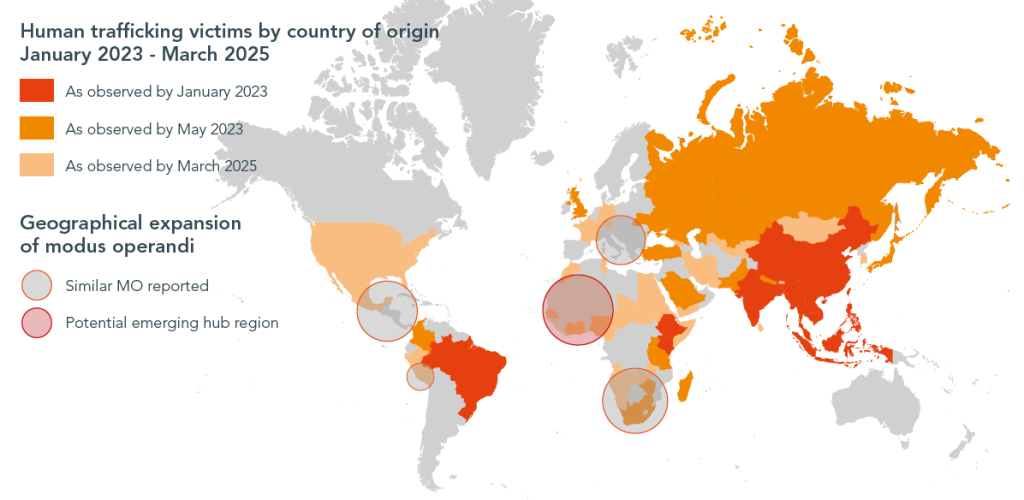
The international policing body said that as of March 2025, trafficking victims from 66 countries have been forced into scam centres, initially concentrated in Southeast Asia but now increasingly found in West Africa, Central America and parts of the Middle East.
These centres often function as industrial-scale operations, where victims are held in compounds and forced to carry out online fraud under threat of violence and coercion.
Interpol analysis of crime data collected over five years shows that 74 per cent of these victims were trafficked into centres located in Southeast Asia. However, the geographical spread of the operations has expanded significantly, with evidence suggesting West Africa may be developing into a new regional hub.
About 90 per cent of human trafficking facilitators were identified as being from Asia, while 11 per cent came from Africa or South America. Most facilitators were men aged between 20 and 39 years, according to the data.
Victims are often recruited under false pretences, typically through fake job advertisements, says the Interpol report. Once recruited, many are detained and subjected to extortion through debt bondage, beatings, sexual exploitation, torture or rape.
Interpol notes that not all those working in these scam centres are trafficking victims, but a substantial proportion are held against their will.
Sophisticated operations
The centres carry out sophisticated online fraud operations, often targeting individuals in other countries through romance scams, investment fraud and social engineering. These scams have resulted in significant financial losses and psychological harm to victims worldwide.
Cyril Gout, Acting Executive Director of Police Services at Interpol, said that dismantling the networks behind these scam centres requires a coordinated international effort.
He called for increased intelligence-sharing between countries, stronger partnerships with NGOs assisting victims, and collaboration with technology companies whose platforms are being exploited.
“The reach of online scam centres spans the globe and represents a dynamic and persistent global challenge,” Gout said. “Tackling this rapidly globalising threat requires a coordinated international response.”
In 2023, Interpol issued an Orange Notice warning of the serious threat posed by these operations. The organisation has since identified the crime trend as a global crisis, with dual layers of harm — both to the trafficked individuals and to the victims of online fraud.
In 2024, police in the Philippines raided a large scam centre as part of a global operation coordinated by Interpol. Dozens of trafficking victims were freed after being forced to work in fraudulent schemes.
That same year, Namibian police, working with international partners, dismantled another scam centre where 88 young people had been coerced into similar scams.
The Interpol report also highlights the increasing role of artificial intelligence (AI) in enabling these operations. AI is being used to create fake job advertisements, generate deepfake images for online scam profiles, and enhance the believability of fraudulent schemes. These advances are making it more difficult for authorities and individuals to detect scams.
The convergence of these scam centres with other areas of transnational crime is also becoming increasingly apparent. Interpol’s analysis shows that the same routes used to traffic people are also being exploited for smuggling drugs, firearms and endangered wildlife. Southeast Asia, the original hub of the scam centre networks, is also known for trafficking in protected species such as pangolins and tigers.
In the Middle East, the growing presence of online scam operations has raised concerns among security officials, particularly regarding the misuse of digital infrastructure to recruit or defraud individuals. Gulf countries, including the UAE, have intensified efforts to detect recruitment scams and enhance their enforcement of cybercrime.
Hero image: Online scam centres often function as industrial-scale operations. Credit: Fidsor