

Web browsing dynamics to change
OpenAI is preparing to roll out its own artificial intelligence-powered web browser in the coming weeks. This development could challenge Google Chrome’s dominance in the global browser market and reshape how users interact with the internet.
Three people familiar with the plans told Reuters the browser would integrate AI at its core, shifting some web navigation from traditional click-based browsing to a conversational, ChatGPT-style experience.
The launch is seen as part of OpenAI’s broader strategy to embed its technology more deeply into everyday consumer and workplace digital habits.
The browser will give OpenAI direct access to user data, a critical asset in the digital economy. That data has long been a cornerstone of Google’s business model, enabling Alphabet to target ads effectively and maintain its lead in online search and advertising. Chrome alone supports a significant portion of Alphabet’s ad revenue, which accounts for nearly three-quarters of the company’s income.
While OpenAI declined to comment on the development, the people speaking exclusively to Reuters requested anonymity because they are not authorised to discuss the matter publicly.
The browser is expected to allow users to perform tasks within a native AI interface, such as asking questions, filling out online forms, or making reservations, without needing to navigate away to traditional websites.
By keeping users within the AI-driven ecosystem, OpenAI could reduce the need for users to visit external pages, potentially disrupting existing online advertising and content discovery systems.
Chromium codebase
The browser is being built on Chromium, the open-source codebase developed by Google and used in Chrome, Microsoft Edge and several other browsers. Two of the sources confirmed that OpenAI’s browser would utilise this foundation, enabling compatibility with existing web standards while layering AI features on top.
This move follows OpenAI’s previous hiring of two former Google executives who were part of the original Chrome development team. The company had reportedly considered acquiring Chrome outright if US regulators succeeded in forcing a divestment of the platform. Still, Google has not made the browser available for sale and has vowed to appeal a ruling declaring its online search business an unlawful monopoly.
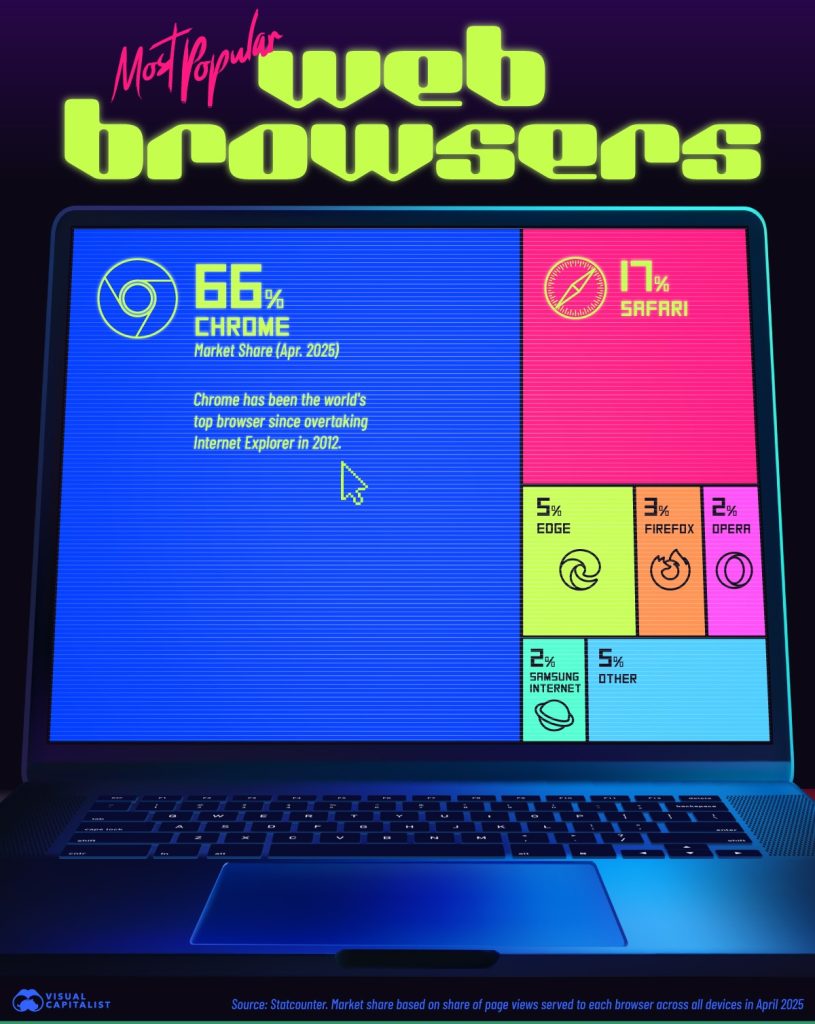
Google Chrome currently holds more than 66 per cent of the global browser market, with over three billion users, according to web analytics firm StatCounter, as reported exclusively by Reuters. Apple’s Safari is a distant second, with about 16 per cent. By contrast, OpenAI’s ChatGPT has 400 million weekly users and three million paying enterprise customers as of last month.
While OpenAI’s browser will enter a market heavily dominated by Google, the timing may prove opportune. Several newer companies, such as The Browser Company and Brave, have launched AI-powered browsers this year.
Another competitor, Perplexity, introduced its Comet browser just last week. These tools are designed to help users complete tasks automatically, reflecting a shift toward AI agents that not only provide information but also act on behalf of users.
In the United States, Chrome’s extensive data collection has drawn legal scrutiny. The US Department of Justice has called for the divestiture of key Google ad-tech operations, arguing that the company’s control over browser-based data gives it an unfair advantage in online advertising.
For OpenAI, ownership of a browser means it could bypass reliance on other companies’ platforms, gaining greater autonomy over data access, search behaviour, and user interaction patterns. One source told Reuters that OpenAI opted against developing a plug-in for existing browsers, instead building its system to maintain complete control over user data and the AI experience.
The browser could also serve as a new distribution channel for OpenAI’s suite of AI tools, including its voice assistant and task automation agent, known internally as Operator. These features are designed to automate routine tasks for users, such as filling out web forms or retrieving specific types of content. Full integration with a web browser would allow these capabilities to operate more seamlessly and at scale.
Middle East viewpoint
From a regional perspective, the introduction of an AI-driven browser could impact digital behaviours in the Middle East, where smartphone penetration and internet usage are among the highest globally. Governments and enterprises in the Gulf are already investing heavily in artificial intelligence infrastructure, and a widely used AI browser could accelerate the adoption of generative AI services in areas such as education, e-commerce and customer service.
Dubai and Abu Dhabi have both announced long-term strategies to become leaders in the field of AI. A shift toward AI-native browsing could be seen as a way to streamline digital services, reduce friction in accessing government portals, and drive innovation in sectors such as fintech, logistics, and public administration.
With Alphabet’s current challenges in US courts, OpenAI may be betting that the browser market is more open to disruption now than it has been at any point in the last decade. While it remains to be seen whether OpenAI’s browser can gain a significant market share, the move represents a direct attempt to break Google’s grip on how information flows online.
As with its earlier breakthroughs in conversational AI, OpenAI’s next step signals its intention to control not just how users ask questions, but also how they find answers and act on them. Whether users will widely adopt the new platform—and whether regulators across regions will scrutinise its data practices—remains to be seen.
Image: In the United States, Chrome’s extensive data collection has drawn legal scrutiny. Credit: Solen Feyissa