The UAE’s waters have never been busier — and the numbers prove it. The GCC catamaran market is now valued at roughly USD 580 million, and industry forecasts point to a climb toward USD 1.1 billion by 2031, expanding at a compound annual growth rate approaching 10%. Behind that trajectory sits a broader story of shifting lifestyles, ambitious tourism agendas and a regional appetite for premium, sustainable marine experiences. At the centre of that story in the UAE stands SilverCat, the power catamaran line from Gulf Craft — a homegrown name that has become synonymous with the segment’s rise.
A Market Built for Catamarans
Catamarans have moved from niche curiosity to mainstream aspiration across the Gulf. Their stability, spaciousness and fuel efficiency make them a natural fit for a region where leisure boating, luxury charters and marine tourism are all expanding at once. Rising disposable incomes, a growing base of private vessel owners and an increasingly sophisticated charter economy have combined to push demand for multi-hull vessels well beyond what monohulls can satisfy on their own.
The UAE, in particular, has emerged as the anchor market. World-class marina infrastructure, yacht-friendly visa frameworks and a packed calendar of exhibitions have turned the country into a magnet for both regional buyers and international charter operators. Add to this a tourism sector projected to contribute more than USD 100 billion to the Gulf’s GDP in the years ahead, and it becomes clear why catamarans — long associated with comfort, space and shallow-draft versatility — are becoming the vessel of choice for operators chasing that growth.
Gulf Craft’s SilverCat: A Homegrown Leader in a Global Category
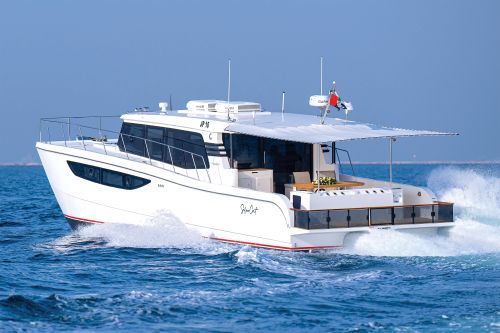
While much of the region’s catamaran supply has historically come from overseas builders, Gulf Craft’s SilverCat range has carved out a distinct position: a UAE-built, UAE-designed power catamaran platform engineered specifically for Gulf conditions and Gulf lifestyles. That local design intelligence — accounting for shallow coastal waters, high ambient temperatures and the entertaining-first culture of Gulf boat ownership — has allowed SilverCat to capture a growing share of a segment increasingly dominated by imported brands.
As the power catamaran category becomes one of the fastest-growing sub-segments in the wider market, driven by demand for speed, efficiency and dual-use flexibility across recreational and commercial applications, SilverCat’s positioning looks increasingly prescient. It offers exactly the combination the data points to: generous deck space for entertaining, efficient cruising for charter economics and a build quality rooted in decades of regional manufacturing expertise. For private owners seeking a personalised marine lifestyle and for charter operators building fleets around guest experience, SilverCat has become a reference point rather than an alternative.
Riding Three Structural Tailwinds
Three forces are converging to sustain this growth and SilverCat sits squarely at the intersection of all three.
Tourism and leisure expansion. Marine tourism activity in the region has grown sharply in recent years, with double-digit increases in the number of on-water excursions, charters and events. As destinations compete to offer differentiated luxury experiences, catamarans — with their stability and social layout — have become the preferred platform for day charters, sunset cruises and private celebrations.
Sustainability and regulation. Regional authorities have moved decisively on environmental standards for new vessels, mandating emissions thresholds and eco-friendly propulsion for newly sold catamarans. Rather than treating this as a constraint, forward-looking regional builders have used it as a design differentiator — investing in lighter materials, improved hull efficiency and propulsion innovation that can cut operating costs by up to a third. This regulatory push plays directly to the strengths of a manufacturer already embedded in the local certification and compliance ecosystem.
Infrastructure investment. With more than a dozen new marinas in various stages of development across the Gulf, docking capacity — long a bottleneck for boat ownership — is set to expand meaningfully. Every new marina berth represents a potential new SilverCat owner or charter deployment, particularly as government agencies, tourism operators and private developers all compete to fill their waterfronts with premium vessels.
Where the Opportunity Goes Next
The next phase of growth is unlikely to be evenly distributed. Industry analysis points to clear white space in a handful of areas: eco-tourism operators seeking purpose-built, low-emission vessels; charter companies scaling fleets to meet demand that is currently outstripping available capacity; and export markets beyond the Gulf looking to source proven, regionally-tested catamaran designs rather than importing from further afield.
This is precisely the opportunity a UAE-manufactured platform like SilverCat is positioned to capture. A local production base shortens delivery timelines in a market where skilled labour and lead times remain a genuine constraint — only a small fraction of the regional marine workforce is currently trained in specialised boat manufacturing and maintenance, according to industry estimates. It also means after-sales support, customisation and warranty servicing can happen close to the customer, a meaningful advantage as charter operators and private owners increasingly weigh total cost of ownership, not just purchase price.
A Segment Still Finding Its Ceiling
What makes this moment significant is that the underlying market is still young relative to its potential. Catamaran penetration in the Gulf remains well below levels seen in more mature boating markets, even as the enabling conditions — tourism investment, marina development, sustainability mandates and a wealthy, leisure-oriented population — are all firmly in place. That gap between current penetration and long-term potential is where the real opportunity lies over the next five years.
For Gulf Craft and for SilverCat specifically, that gap represents runway rather than risk. As the region’s catamaran market roughly doubles in size by the turn of the decade, the builders best placed to benefit will be those already manufacturing locally, already compliant with tightening environmental standards and already trusted by the private owners and charter operators driving demand. On the UAE’s waters today, SilverCat is doing exactly that — turning a regional growth story into a homegrown manufacturing success.