As global cost of cybercrime rises
Saudi Arabia is expanding its role in international policing, following a high-level visit by its Minister of Interior, Prince Abdulaziz bin Saud bin Naif bin Abdulaziz, to Interpol’s headquarters in Lyon, France.
The visit marks a significant step in the Arabian Gulf state’s preparations to host Interpol’s Regional Bureau for the Middle East and North Africa (MENA).
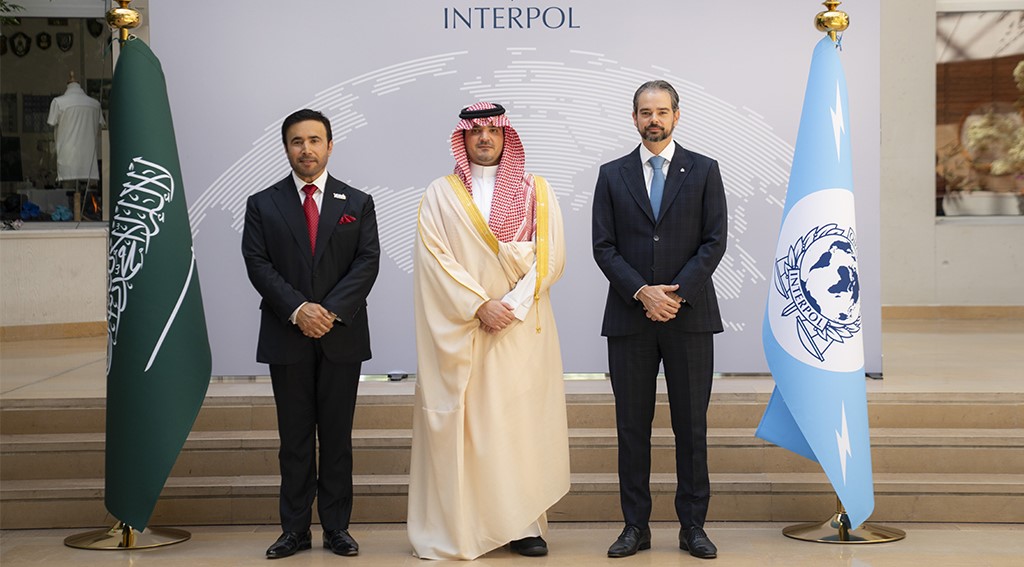
The meeting brought together Prince Abdulaziz, Interpol President Ahmed Naser Al-Raisi of the United Arab Emirates, and the organisation’s new Secretary General, Valdecy Urquiza of Brazil. The talks focused on enhancing cooperation in tackling transnational threats, including cybercrime, financial fraud and terrorism.
Saudi Arabia is positioning itself as a key player in global policing efforts, with plans to support regional coordination through the upcoming Interpol MENA bureau. The Riyadh-based hub is expected to improve intelligence sharing and joint operations across the region, which continues to face persistent challenges from organised crime and illicit networks.
During the visit, Prince Abdulaziz and his delegation were briefed on Interpol’s work in digital security and border control. Officials highlighted the growing threat of cybercrime, which has risen sharply in the Middle East.
According to Interpol, the global cost of cybercrime is projected to reach $10.5 trillion annually by 2025, with the region increasingly targeted due to its growing digital infrastructure and financial systems.
Saudi Arabia has been a financial contributor to Interpol’s I-Core programme, aimed at modernising international police cooperation through digital transformation. The programme includes efforts to streamline data exchange, improve identity verification and integrate new technologies across policing networks.
Secretary General Urquiza acknowledged the Kingdom’s role in advancing these reforms. He said Saudi support was enabling Interpol to build a more cohesive and effective international response to emerging threats.
President Al-Raisi, a UAE national, also highlighted the importance of the visit in reinforcing regional partnerships. He said that Saudi Arabia’s commitment reflects the shared goals of MENA states to improve security coordination in response to growing cross-border threats.
Saudi officials have stressed that the partnership with Interpol is aligned with the country’s broader strategy for national and regional security. Riyadh has been investing heavily in law enforcement and digital infrastructure, in line with Vision 2030 objectives.
The minister’s visit comes at a time when the MENA region is facing increased instability, with ongoing conflicts and economic uncertainty in parts of Africa and the Middle East creating fertile ground for criminal networks. The role of Interpol in supporting member countries to dismantle such operations has become more crucial, particularly in areas with limited cross-border law enforcement cooperation.
Prince Abdulaziz was accompanied in Lyon by Hesham Al-Faleh, Assistant Minister of Interior, and Fahd bin Mayouf Al-Ruwaili, Saudi Ambassador to France, along with other senior officials.
Interpol’s MENA Regional Bureau, once operational, is expected to support over 20 countries, offering a central point for collaboration on criminal investigations, intelligence gathering and coordinated policing action across the region.
Image: Saudi Arabia is positioning itself as a key player in global policing efforts, with plans to support regional coordination through the upcoming Interpol MENA bureau. Credit: Interpol