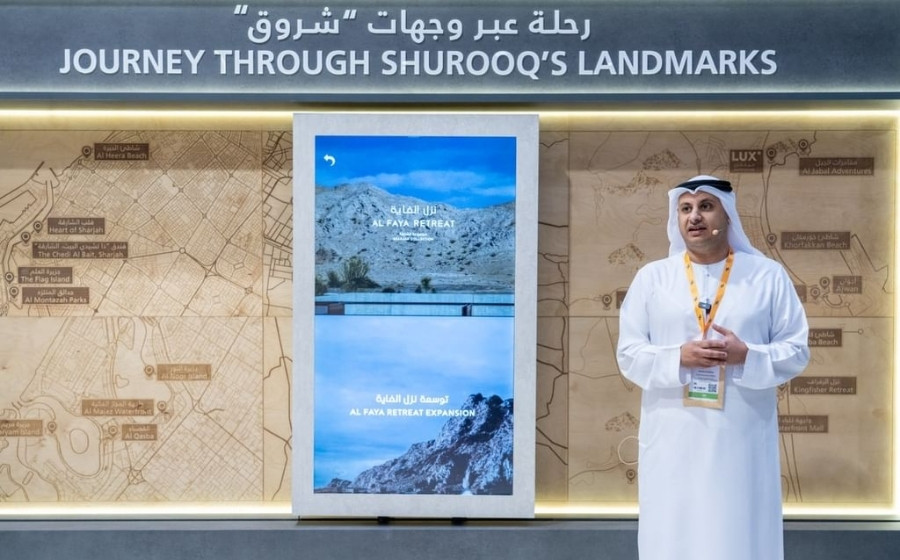
Photo Credit : WAM
The Sharjah Investment and Development Authority (Shurooq) has announced a major expansion of Al Faya Retreat during its 19th consecutive participation at Arabian Travel Market (ATM) 2026, with the property’s accommodation capacity set to increase from five rooms to 20 units by the fourth quarter of 2026.
The expansion is part of Shurooq’s wider strategy to connect hospitality development with sustainable cultural tourism, enabling more visitors to stay in Mleiha while maintaining the retreat’s privacy and strong relationship with the surrounding desert environment.
Minor Hotels is scheduled to take over the management and operation of the Sharjah Collection from October 2026.
Shurooq presented the expansion during a press conference at ATM 2026, outlining the project’s strategic direction, architectural approach and plans for enhancing the guest experience.
Located within Mleiha National Park, Al Faya Retreat sits close to the UNESCO World Heritage-listed Faya site, which offers significant archaeological evidence of human presence and adaptation to desert environments over thousands of years.
Shurooq said the location gives the retreat a role that extends beyond accommodation, positioning it as a gateway for visitors seeking to explore the archaeological, environmental and cultural heritage of Mleiha through a responsible tourism experience.
Al Faya Retreat forms part of Sharjah Collection, a portfolio developed by Shurooq to provide hospitality experiences shaped by the natural landscapes, history and cultural identity of each destination.
The expansion is expected to allow more guests to extend their stays in Mleiha and explore the area’s archaeological sites, desert landscapes, natural formations and night skies, while also taking part in relaxation and wellness experiences.
Shurooq said the development would further strengthen the retreat’s role in cultural tourism by helping visitors understand the historical and environmental importance of the area rather than viewing the desert solely as a backdrop for accommodation.
Ahmed Obaid Al Qaseer, CEO of Shurooq, said Al Faya Retreat has maintained a clear identity since its launch, with its limited accommodation capacity helping protect the privacy and character of the experience.
He said the expansion would allow the destination to welcome more visitors without changing the elements that make the retreat distinctive.
According to Al Qaseer, Shurooq’s approach to tourism investment focuses on creating genuine value for both destinations and visitors while protecting the natural, cultural and archaeological features that define them.
He added that growth should not simply mean increasing the size of a destination, but allowing it to develop in a way that remains appropriate to its setting and identity.
Khawla Al Hashimi, Chief Projects Officer at Shurooq, said the design philosophy behind the expansion places equal importance on what is left untouched and what is constructed.
She said the project team considered the full guest journey, including arrival, movement between spaces, views and the balance between openness and enclosure.
The architecture has been intentionally designed to remain understated, allowing the desert environment to remain the dominant feature of the experience.
Amir Golbarg, Chief Operating Officer for the Middle East and Africa at Minor Hotels, said the company was pleased to support the next phase of Al Faya Retreat.
He said Sharjah Collection has a distinctive identity and that Minor Hotels would bring its international hospitality expertise while ensuring each property continues to reflect the individual character of its destination.
Al Faya Retreat currently occupies two restored buildings dating back to the 1960s, including a former medical clinic and a shop located beside Mleiha’s oldest petrol station. The historic fuel pump at the site has also been preserved.
The buildings were previously converted by Shurooq into the retreat’s original five rooms and will now be transformed into spa and wellness spaces while remaining central to the architectural identity of the property.
The new accommodation units have been designed to increase capacity while protecting the site’s archaeological and environmental character.
Each unit will be positioned individually across the desert terrain to maintain privacy and open views while reducing its visual impact on the surrounding landscape.
The units are also designed to respond to high temperatures and solar exposure.
Shurooq said the accommodation structures will be manufactured off-site, reducing construction activity, excavation and material storage within the destination and helping minimise direct intervention in the natural environment.
Because of Mleiha’s archaeological and environmental importance, the expansion will build on the retreat’s existing facilities and operational infrastructure rather than creating a separate hospitality development.
This approach is expected to help avoid unnecessary duplication of infrastructure while limiting the overall development footprint.
The additional accommodation capacity is also expected to support local hospitality, transport, guided tours and other visitor-related services.
Shurooq said the expansion will contribute to strengthening Mleiha’s position as a year-round cultural tourism destination while taking into account the site’s carrying capacity and maintaining the quality of the visitor experience.