Photo Credit: WAM
Dubai, UAE — November 2025 — The United Arab Emirates is solidifying its role as a global leader in advanced aerial mobility through a landmark initiative to create pioneering regulatory frameworks.
Spearheaded by the Technology Innovation Institute and ASPIRE, both pillars of the Advanced Technology Research Council, in partnership with the General Civil Aviation Authority, the project is establishing data-driven, simulation-based regulations for integrating crewed and uncrewed aerial vehicles into national airspace.
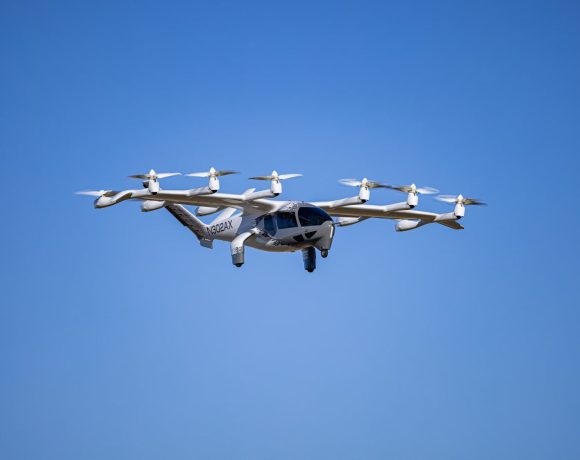
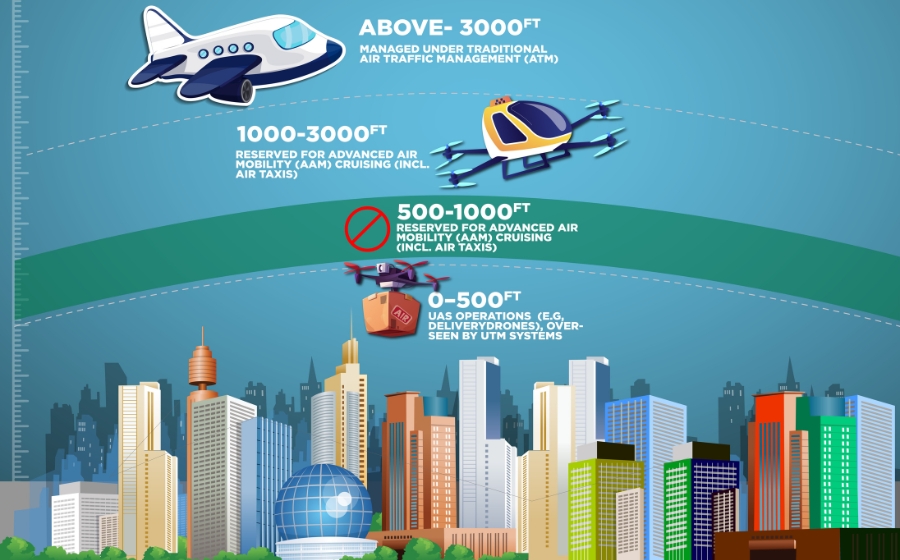
This effort, managed by the Council for Autonomous Systems, positions the UAE among a select few nations piloting such advanced frameworks. It focuses on developing air corridor models and operational standards for emerging technologies like air taxis and drone logistics, as reported by the Emirates News Agency.
To inform these future airspace designs, field simulations are currently underway at key testbed sites: Yas Island, Zayed Port, and Abu Dhabi International Airport. These tests, supported by advanced modelling tools developed with the California Institute of Technology, are analyzing critical variables such as wind patterns, safety limits, and flight dynamics.
Leadership figures across the collaborating entities have emphasized the critical link between technology and regulation. Najwa Al-Araj, Chief Executive Officer of the Technology Innovation Institute, stated that technology alone is insufficient for a true breakthrough in urban air mobility; it must be accompanied by forward-looking regulations that address the complexities of autonomous flight.
Echoing this sentiment, Andrew Strefford, Executive Director at ASPIRE, said that urban air mobility is not solely about new technology, but also about trust and safety. “Policies and regulations are therefore essential to its adoption. What we are establishing in Abu Dhabi lays the foundation for global confidence in how future cities will communicate and operate their urban and suburban airspaces, opening up new economic opportunities across mobility and logistics sectors,” he added.
From the regulatory perspective, Aqeel Ahmed Al Zarooni, Assistant Director-General for Aviation Safety Affairs at the GCAA, said: “As aviation continues to evolve, our regulatory frameworks must evolve with it.”
Through this collaboration with TII and ASPIRE, Al Zarooni noted that GCAA is laying the foundation for the safe and scalable integration of next-generation aerial mobility, to ensure harmony between manned and unmanned air traffic systems.
The project’s comprehensive approach is structured across four key workstreams: designing safe air corridors, establishing vehicle separation standards, coordinating traditional and unmanned air traffic management, and providing regulatory advisory support.
By uniting advanced research, simulation technologies, and cross-sector collaboration, the UAE is setting global benchmarks for the governance of urban air mobility, reinforcing Abu Dhabi’s status as a testbed for next-generation transport regulation and a model for smart cities worldwide.