In La Plata city
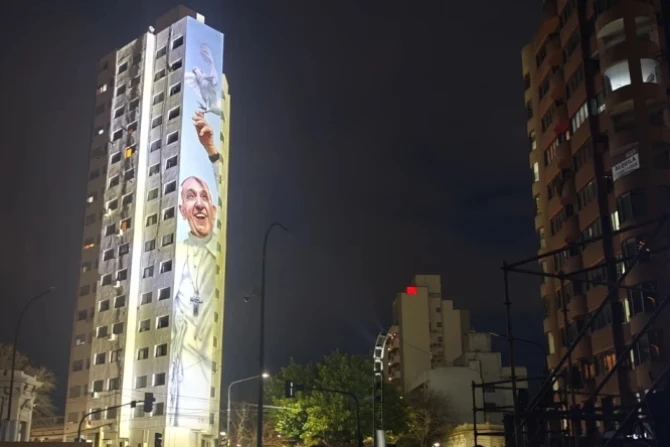
A 50-metre tall mural of Pope Francis has been unveiled in the Argentine city of La Plata, marking the world’s largest known public artwork dedicated to the late Catholic pontiff.
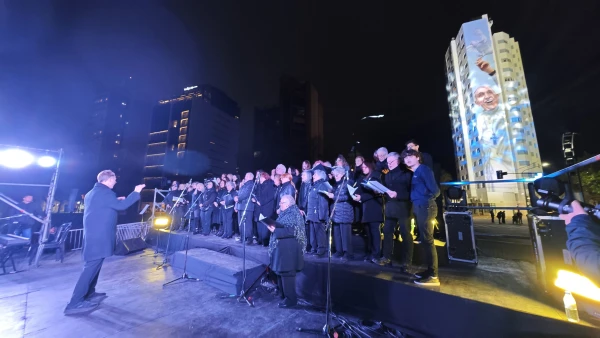
The mural, painted by Argentine street artist Martín Ron, was officially inaugurated on July 26, 2025, in a ceremony attended by city officials, Catholic Church leaders, and members of the public.
Located just metres from the city’s Immaculate Conception Cathedral, the mural portrays Pope Francis releasing a dove skyward. The image, selected from the early days of his papacy, was chosen for its symbolic association with peace and hope.
At 50 metres tall and five metres wide, the artwork dominates the urban skyline at the intersection of 54th and 14th streets in La Plata’s central Plaza Moreno.
The mural is already drawing comparisons with other Argentine icons depicted in Ron’s work, such as football legends Diego Maradona and Lionel Messi. In a country where religion, football and politics often intertwine in public life, Pope Francis — born Jorge Mario Bergoglio in Buenos Aires — holds a uniquely powerful position in the national consciousness.
Pope Francis, born Jorge Mario Bergoglio on December 17, 1936, passed away on April 21, 2025. He served as the 266th pope of the Catholic Church from March 13, 2013, until his death. Notably, he was the first Jesuit to become pope, the first pontiff from Latin America, and the first from the Western Hemisphere.
Although widely recognised as a spiritual leader, Pope Francis’ image has also become deeply symbolic in Argentina’s cultural and political discourse. Since becoming the first Latin American pope in 2013, Francis had taken strong stances on poverty, inequality and environmental justice — topics that resonate across Latin America, the Middle East and Africa.
The artist
Martín Ron, one of Latin America’s most prominent muralists, said the decision to paint the pontiff in such scale was driven both by artistic intent and public interest.
“Painting figures with strong popular resonance is part of what muralism is about,” Ron said during the unveiling. “It contributes to collective memory, especially in spaces where traditional art doesn’t reach.”
He added that the mural’s technical complexity stemmed not only from its scale but also from the narrow vertical format of the wall. The structure limited the composition options, ultimately leading Ron to choose a vertical image that aligns with the wall’s shape and its visibility from the surrounding plaza.
The image of the pope holding a dove was considered especially suitable because of its spiritual symbolism in Catholic iconography. The dove, associated with the Holy Spirit and peace, reinforces the message behind the artwork at a time of global uncertainty, particularly across conflict-affected regions like the Middle East and parts of Africa.
The installation was commissioned by La Plata’s city council and is expected to become a major religious and cultural attraction. Local officials, including Mayor Julio Alak, were present at the blessing, led by Archbishop Gustavo Carrara. The archbishop described the mural as a reflection of the city’s aspiration to become “a space of encounter and fraternity.”
Pope Francis was a highly influential global figure. His papacy had been marked by efforts to decentralise Church authority, promote interfaith dialogue, and address social justice issues.
Papal first
In the Middle East and North Africa (MENA) region, his visit to the UAE in 2019 was a historic milestone — the first papal visit to the Arabian Peninsula. During that trip, he signed the Document on Human Fraternity with the Grand Imam of Al-Azhar, signalling efforts to bridge Christian-Muslim divides.
For observers in the Arabian Gulf and North Africa, the La Plata mural can be seen as an extension of that message. The depiction of the late pope as a messenger of peace resonates with regional conversations about tolerance.
From a regional tourism perspective, the mural may also attract visitors from Latin America’s large Catholic diaspora communities, including those based in the UAE and other parts of the Middle East. According to the Pew Research Center, over 40% of Latin Americans identify as Catholic, with Argentina alone accounting for nearly 30 million adherents.
Ron, who is not a practising Christian, said he nonetheless felt it essential that Church officials bless the artwork. “The key is not who paints it, but how people receive it,” he added. “It is not just a mural. It could become a place of reflection or even pilgrimage.”
In Argentina, where nearly 62% of the population identify as Roman Catholic, according to the Latinobarómetro, the mural may well become a new spiritual stop. Religious tourism already plays a notable role in Latin American economies, and such installations can contribute to both local identity and economic activity.
La Plata’s new landmark is expected to attract attention not only from Catholic pilgrims but also from street art enthusiasts, scholars of religious imagery, and those interested in the intersection of public space, faith and culture.
As for Ron, he believes the mural will endure beyond headlines and political cycles. “When the image connects with people — when it becomes part of their daily landscape — that’s when it matters most,” he said.
The Catholic News Agency first published this story.
Hero image: Official inauguration ceremony of the 50-metre tall mural of Pope Francis in La Plata, Argentina, on July 26, 2025. Credit: Municipality of La Plata