
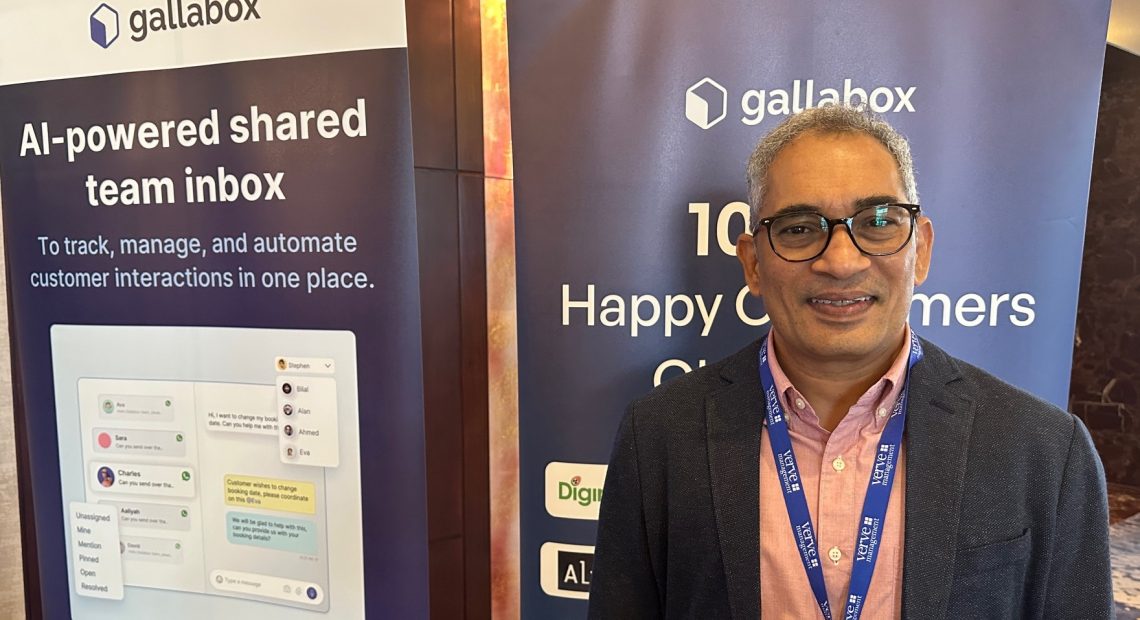
Says Co-Founder Karthik Jagannathan
As digital tools reshape how businesses connect with customers, companies offering solutions must navigate a fast-evolving technology landscape.
In this exclusive interview on the sidelines of CX & Loyalty Summit 2025 in Dubai, Karthik Jagannathan, Co-Founder and CEO of Gallabox – a no-code WhatsApp-led customer engagement platform – shares his insights on the challenges of being a tech solutions provider today, the company’s R&D roadmap, democratising technology, and how Gallabox is positioning itself for growth.
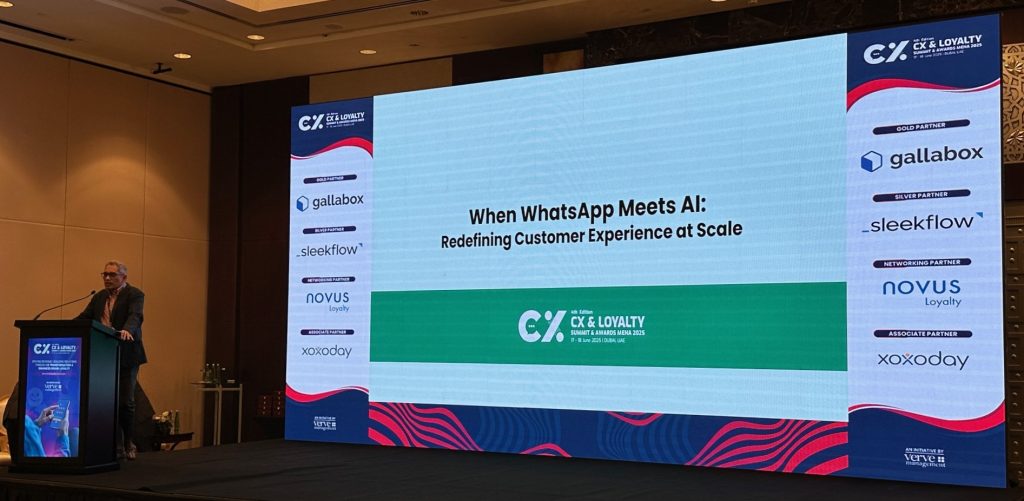
Gallabox is headquartered in San Diego, United States, and was founded in 2020 with $3.5 million seed capital from three investors. The company specialises in business solutions that encompass conversational CRM, WhatsApp business automation, WhatsApp chatbots, WhatsApp shops, and WhatsApp commerce. Gallabox was a gold sponsor of the CX & Loyalty Summit 2025, where Middle East News 247 was also a media partner.
Excerpts from the interview.
Why did you co-found Gallabox? What gap in the market do you aim to address?
My co-founders and I—there are three of us—spent a significant amount of time at Sulekha, a local services marketplace serving thousands of small to medium-sized businesses (SMBs) in India and the US.
We noticed that many of these businesses struggled to convert leads into sales. The root of the problem was outdated communication tools—SMS, email, and call centres—while customers had already moved on to WhatsApp.
Understanding that people prefer to interact on platforms they already use, we at Gallabox recognised the practicality of WhatsApp. It’s a platform that’s ubiquitous and familiar, even down to those daily “good morning” messages from family. So, we created Gallabox to bridge that gap, helping businesses move conversations to WhatsApp to improve conversions. From there, we have expanded to other channels, such as Instagram and websites, but it all started with WhatsApp.
What makes WhatsApp such a unique platform for business communication compared to others?
Firstly, WhatsApp is the most widely used app on people’s phones—you can confirm this by checking your battery or screen time. Consumers live inside WhatsApp. It’s not just another app; it’s a trusted digital environment for people. They chat with family, friends, colleagues—everyone.
Secondly, it [WhatsApp] offers powerful automation capabilities. Businesses can run AI workflows, chatbots, and even transaction flows directly within WhatsApp. Unlike SMS, email, or call centres, WhatsApp allows real-time, two-way, interactive communication. It is a platform where brands can truly engage and delight their customers. No other platform combines scale, automation, and familiarity like WhatsApp.
Gallabox has a global clientele. What makes the GCC region particularly attractive to your company?
One of the most significant factors is that the GCC region is WhatsApp-dominant. Take the US—despite Meta owning WhatsApp, adoption there is relatively low. But in the GCC, WhatsApp is the primary communication tool, both personally and professionally.
More importantly, business in this region [GCC] is built on relationships, trust, and rapport. Unlike purely transactional markets, here [GCC] people prefer to meet and talk, often in person. WhatsApp provides a perfect digital parallel to that. It is a channel that already holds their trust. We see it as the best way to translate traditional relationship-building into the digital world.
Could you share a real-world example of how a client—say, in real estate—is using Gallabox?
Real estate is a great use case. Developers run campaigns to generate leads—such as ads, project launches, and social media—but the disconnect often lies between the marketing and sales teams. Sales do not always follow up quickly or effectively.
We help real estate companies utilise WhatsApp to immediately engage leads—asking questions about location, budget, size, and more—and guide users through a tailored discovery journey.
We schedule virtual tours, set up site visits via WhatsApp’s calendar integration, and even send real-time updates about project approvals or inventory. Everything—from lead nurturing to documentation—happens in WhatsApp, offering an end-to-end customer experience that is far more seamless and engaging than phone calls or emails.
As a tech company, how do you approach R&D and innovation? Especially given how fast WhatsApp and related technologies are evolving?
We follow a structured product roadmap based on two pillars. First, we listen to existing customers—what they explicitly request and what their usage data implicitly reveals.
Second, we look ahead—what is coming in AI, automation, or customer experience (CX)? We ask ourselves: Is this scalable? Is it monetisable? Can it be self-served?
Only ideas that pass all three filters move forward. The goal is to build features that not only respond to today’s needs but also anticipate what tomorrow will be. That is how we stay ahead, especially in fast-changing ecosystems like WhatsApp.
WhatsApp is initially rolling out commercial content in select markets. As a regular user, how will that affect someone who primarily uses WhatsApp for personal chats?
That is a valid concern. WhatsApp has always been a deeply personal space, and there is a risk that it could follow the path of email, which has become spam-heavy.
However, WhatsApp remains one of the most personalised and user-controlled platforms. You can block senders, mute conversations, and control your exposure. Unlike SMS or email, you have significantly more control over filtering content.
The system is expected to be intelligent, only showing you relevant content based on your behaviour and interests. There is also a clear separation between personal chats and promotional messages. As long as this balance is maintained, WhatsApp can offer value without being intrusive.
Given the surge in AI tools and generative tech, won’t users feel overwhelmed? For example, can they use ChatGPT directly in WhatsApp?
Absolutely. What is exciting is how democratised AI has become. Meta is embedding its own AI into WhatsApp and Instagram. Meanwhile, users can integrate ChatGPT into WhatsApp independently. This gives people a choice. AI is not here to replace us—it is a toolkit.
Just as people feared when Google arrived, that we would stop reading books, AI has enhanced our ability to learn and find answers. Similarly, AI on WhatsApp helps users with everything—from creating messages to finding jokes to scheduling meetings. It is about enhancing human capability, not replacing it.
What are the biggest challenges you face as a solutions provider in the fast-evolving digital landscape?
The pace of change is the biggest challenge. User preferences, platform APIs, and regulations—they evolve rapidly.
Our key challenge is staying ahead without overwhelming users or clients. We must innovate thoughtfully, ensure every feature adds value, and maintain user trust. Another key aspect is maintaining simplicity.
With so many options, tools, and technologies, our job is to simplify it for the end-user. Gallabox is not just a tech provider—it is a guide through this digital shift. We help clients navigate complexity while keeping their customer experience simple, personal, and impactful.
We are at a tectonic phase of transformation. New tools and technologies are emerging at an unprecedented rate. While this is exciting, it is also overwhelming, especially for businesses that are trying to keep up. The abundance of options can hinder decision-making.
As a tech leader, one of my biggest challenges is helping clients cut through the noise and find clarity. That means educating, informing, and even evangelising — not just selling a product. Sometimes, we have to step up and say, “This is what’s right for you,” even when there is no immediate benefit to us. The ability to guide businesses in making the right tech choices is now critical.
We often compare it to choosing a smartphone. Once you are in the Apple or Android ecosystem, your path is pretty set. In the tech solutions world, we are not there yet. Over the next few years, we hope platforms like ours will become as intuitive and essential as iOS or Android systems, allowing businesses to choose and commit to a solution without distraction, confidently.
What are your R&D goals for the next two to five years?
A big part of our mission is democratising technology. What was once accessible only to large enterprises should now be available to every business, regardless of its size and scope. We are committed to making powerful communication tools accessible and user-friendly.
Of course, there are headwinds. The paradox of choice is fundamental. However, there is also a significant tailwind: customer expectations have undergone a dramatic shift. Businesses now view customer touchpoints as critical growth levers. We want to help them seize that opportunity.
From an R&D perspective, our goals are threefold. First, customer acquisition — not just volume, but the right kind of customers who can truly benefit from our platform.
Second, we aim to build an organisation people love working for. I often joke that I raise the average age of our team when I walk into a room — we work with a dynamic group of young professionals who are passionate about our vision.
And third, we want to help our customers grow their businesses. It is in our name — Galla in many Indian languages means ‘cash register’. Even before we decided what product to build, we knew we wanted to help businesses improve their bottom line. One of our Key metrics is measuring the contribution we have made to our clients’ growth, whether that is in percentage points or exponential jumps.
Are you targeting primarily private sector clients, or is there scope for public sector collaborations as well?
While much of our work is with private businesses, we have already partnered with several government entities in India, including ports, electricity boards, and housing authorities. These are high-volume engagements that demonstrate the widespread adoption of digital transformation.
In the Middle East, we are also in talks with several public sector bodies. What is interesting is that the line between public and private is increasingly blurred. Citizens expect the same level of service from a government entity as they do from a company like Amazon. Whether they are applying for permits or accessing public services, people want intuitive, seamless digital experiences.
Governments are recognising that, and we are stepping in to help them meet those expectations. It is no longer about the sector — it’s about the customer experience. And that is where we bring value.
Hero image: Karthik Jagannathan, Co-Founder and CEO of Gallabox. Credit: Arnold Pinto