The UAE Ministry of Education has highlighted its efforts to integrate environmental sustainability into public education and equip students and teachers with the skills needed to address climate challenges during the 31st United Nations Climate Change Conference (COP31) in Antalya, Türkiye.
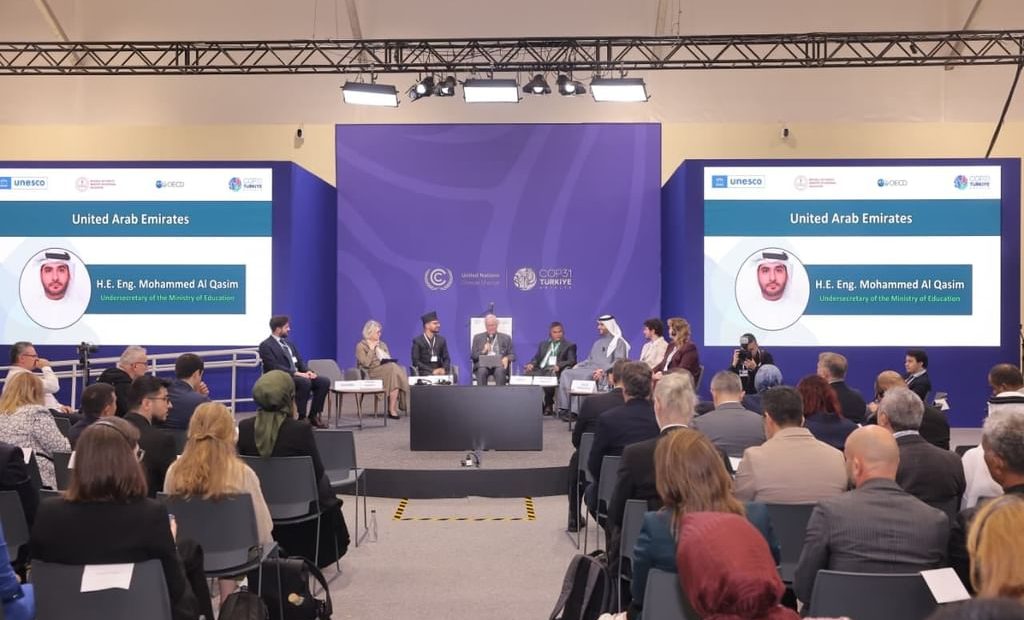
Eng. Mohammed Al Qasim, Undersecretary of the Ministry of Education, outlined the country’s approach to climate education while participating in the High-Level Ministerial Opening Session, held as part of Children, Youth, Education and Skills Day.
During the session, Al Qasim emphasised the importance of preparing educators to address environmental challenges while encouraging young people to contribute to a more sustainable future.
He also joined a panel discussion titled “Youth and Teachers to Ministers: Where Do We Go from Here?”, organised under the Antalya Protocol for Action, which places children, young people and teachers at the centre of efforts to promote greener education.
The discussion was hosted by the COP31 Presidency, Türkiye’s Ministry of National Education and the Greening Education Partnership, in collaboration with UNESCO and the Organisation for Economic Co-operation and Development (OECD).
Participants explored how education systems can support climate change mitigation and adaptation, strengthen resilience to environmental risks and incorporate sustainability into teaching practices.
The discussions also addressed climate-resilient schools, equal access to education, climate justice and the need for stronger international cooperation to turn global climate commitments into practical national initiatives.
Al Qasim pointed to the UAE’s major clean energy developments, including the Shams Solar Power Plant, Mohammed bin Rashid Al Maktoum Solar Park, Al Dhafra Solar PV project and Barakah Nuclear Energy Plant, as examples of the country’s commitment to sustainability.
He stressed that maintaining and expanding such projects requires continued investment in skilled professionals and human capital development.
According to Al Qasim, the Ministry’s sustainability education strategy focuses on three key areas: curricula, teachers and students. Environmental concepts are incorporated into subjects such as science, technology, mathematics, geography and social studies.
The Ministry also works with UNICEF to provide teachers with training in sustainability principles and teaching methods. Additional specialised training programmes are delivered throughout the academic year to strengthen educators’ capabilities.
For students, sustainability education extends beyond classroom lessons through extracurricular activities, practical projects and hands-on learning opportunities. Student projects are evaluated according to clearly defined standards to encourage meaningful outcomes.
Al Qasim highlighted the Ministry’s efforts to promote innovation through STEM competitions and forums, including the recently organised National Science, Technology and Innovation Forum, which attracted more than 4,000 applications for projects related to technology and sustainability.
Students are also encouraged to protect their innovations by obtaining intellectual property rights through the Ministry of Economy, supporting the development of practical solutions and potential entrepreneurial opportunities in sustainability-related sectors.
He explained that the Ministry aims to move beyond theoretical learning by encouraging students to apply their knowledge to real-world environmental challenges and consider careers in sustainable industries.
The UAE’s participation at COP31 builds on its ongoing cooperation with UNESCO, including initiatives introduced during COP28, such as the Greening Education Hub, to promote sustainability within education systems.
Through its engagement at COP31, the Ministry reaffirmed its commitment to strengthening climate education, developing teacher capabilities, supporting student-led innovation and expandi