Amid Indo-Pacific tensions
Military forces from across the Indo-Pacific demonstrated advanced combat coordination during a major multinational live-fire exercise on July 14, 2025, as part of Exercise Talisman Sabre 25, held in Queensland, Australia.
The joint drill reflected increasing regional security concerns and efforts to improve military interoperability among allied nations.
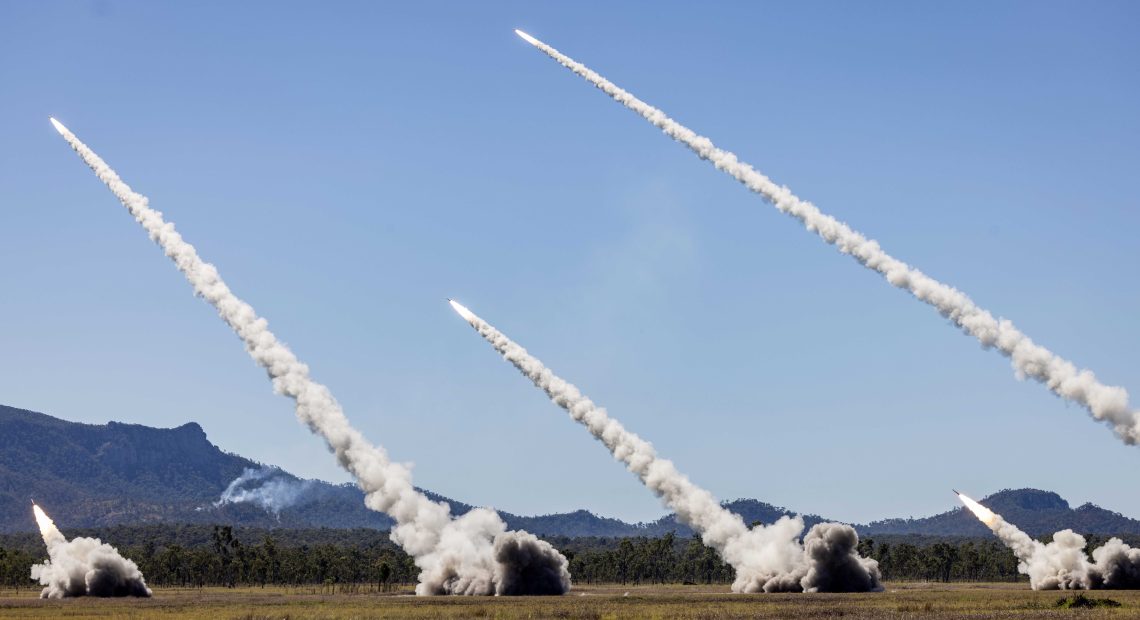
Under clear skies, High Mobility Artillery Rocket Systems (Himars) and other long-range weapons were launched during a complex simulation aimed at testing joint manoeuvres across air, land and digital domains.
The scenario involved synchronised attacks, targeting data sharing and coordinated armoured movements by military units from Australia, the United States, Singapore, South Korea and Japan.
The exercise began with US Marine Corps F-35B Lightning II fighter jets conducting airstrikes to ‘neutralise mock enemy air defences’. With air superiority secured, Himars units from the US Army, the Australian Defence Force (ADF), and the Singapore Armed Forces launched precision-guided munitions from concealed positions.
The operation was supported by a multinational intelligence network using unmanned aerial platforms to provide real-time targeting data.
Military observers and senior commanders from participating nations watched as live munitions struck designated targets, simulating rapid battlefield decision-making. The exercise highlighted how allied forces can share sensor data across platforms, enabling one country to detect a threat and another to engage it.
The event marked a first for Australia, as it conducted a live Himars launch on its territory with partner nations. Defence analysts say the move signals Australia’s ongoing shift toward greater self-reliance in its military supply chains, with plans to manufacture advanced munitions locally.
As geopolitical tensions persist in the Indo-Pacific, exercises like Talisman Sabre have assumed new importance. Although not directly tied to any one adversary, the scale and sophistication of the drills send a message of military readiness and unity.
While the Middle East was not directly involved, several regional nations have shown interest in similar joint training frameworks to counter evolving threats in their theatres, including missile and drone warfare.
Following the long-range strikes, M777A2 155mm howitzers from the US Marine Corps and ADF provided suppressive fire, clearing the path for South Korea’s K9A1 and K1A2 systems to conduct a simulated armoured assault.
The exercise concluded with Japan’s Ground Self-Defence Force deploying its Chu-SAM medium-range air defence system to protect rear-area assets from airborne threats, further demonstrating the importance of integrated defensive capabilities.
US Army Lieutenant Colonel Edward Guelfi, who led one of the participating field artillery battalions, noted that the exercise’s success extended beyond the weapons systems. He said troops quickly adapted to different procedures and equipment, showing that trust and shared doctrine were key to interoperability.
While Talisman Sabre has traditionally been focused on the Pacific, the growing convergence of defence interests globally, particularly regarding missile deterrence and digital warfare, makes the lessons from this exercise relevant well beyond Australia. Middle Eastern partners watching developments in the Indo-Pacific may seek to deepen their defence ties with key allies participating in these exercises.
Military analysts have noted that as threats become more multidimensional and unpredictable, exercises such as Talisman Sabre provide a testing ground not just for technology but also for decision-making structures, alliance coordination, and battlefield resilience.
As Australia’s defence posture continues to shift and regional coalitions evolve, such training efforts could serve as a model for similar collaborations in other high-risk theatres, including parts of the Middle East and the Horn of Africa.
The 2025 iteration of Talisman Sabre involved live combat scenarios designed not only to showcase advanced systems but to develop the human and procedural foundations of future joint responses.
Image: High Mobility Artillery Rocket Systems from the Australian army, the US Army and the Singapore army fire multiple rockets during a combined joint live-fire exercise in Queensland, Australia, on July 14, 2025. Credit: Australian Defence Force