

By Slava Vaniukov, CEO and Co-Founder, Softermii
This guide is designed to help companies of all sizes navigate the complexities of adopting AI. It will help you understand what’s possible, how to start, and how to move from experimentation to scalable solutions.
Regardless of your size or sector, the strategic use of AI can redefine your roadmap. Our guide is designed for organisations at every stage of growth:
- Startups looking to build AI-powered features from the ground up or pivot using pre-trained models;
- SaaS companies aim to differentiate their product by embedding intelligent automation and predictive analytics;
- SMEs seeking efficiency gains by automating workflows and reducing manual overhead;
- Enterprises ready to transform legacy systems with intelligent capabilities.
Why AI Is Reshaping Business in 2025
AI has moved from experimental to essential. The Artificial Intelligence market is expected to grow at a CAGR of 33.83%, reaching $2.53 trillion by 2033, up from $184.15 billion in 2024.
Today, it’s redefining how businesses create products, serve customers, and make decisions. This year marks a turning point: companies that act now build long-term resilience and competitive advantage.
Innovators utilise AI to automate repetitive tasks, minimise operational overhead, enhance customer experiences through real-time personalisation, and make data-driven decisions more quickly than ever. It’s about augmenting teams with intelligent systems to unlock scale and agility. For modern digital businesses, AI has become a foundational element.
What’s Changed: The 2025 AI Landscape and Major Benefits
Businesses no longer need massive R&D budgets to benefit from AI. They need a focused strategy and the right development partner. Here are some key shifts that have made AI adoption more accessible and impactful in 2025:
- Lower technical barriers. No-code and low-code AI platforms now allow for faster prototyping and deployment.
- Cost-efficiency. Cloud-based AI services have reduced infrastructure costs. Now, enterprise-grade models are more available to startups and SMEs.
- Regulatory maturity. Clearer global frameworks around responsible AI and data privacy have improved trust and simplified compliance.
- Better tools and models. Open-source frameworks and commercial APIs allow for the integration of vision, language, and recommendation systems with minimal friction.
Benefits of AI Implementation
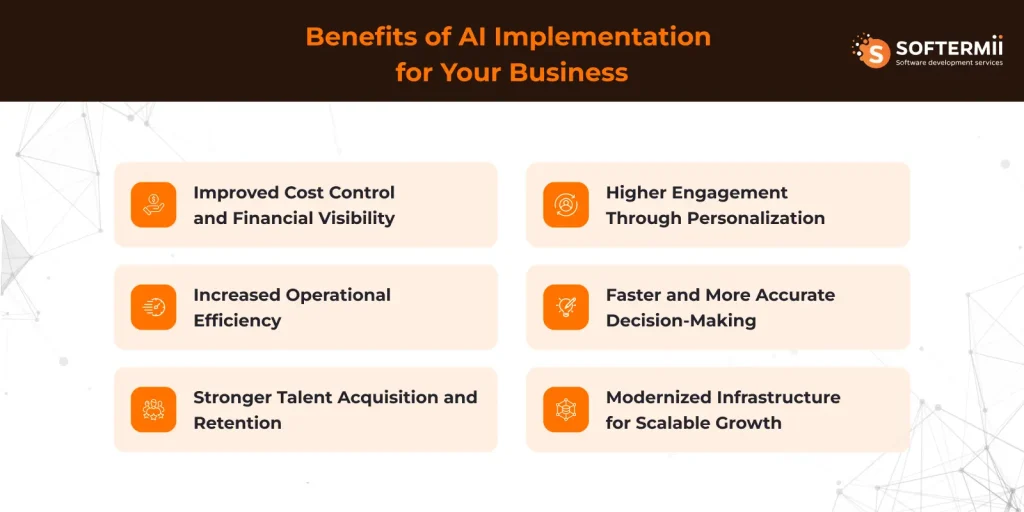
AI delivers tangible results for businesses to move beyond manual processes and legacy systems. It addresses critical pain points across operations, finance, customer experience, and talent management. Here are some of the measurable gains:
Improved Cost Control and Financial Visibility
AI-powered financial modelling enhances forecasting, budgeting, and scenario planning. It allows for making smarter and faster decisions from the top down. Thus, companies benefit from 5–15% lower operational costs and clearer insight into financial performance.
Higher Engagement Through Personalisation
By leveraging machine learning, organisations can deliver dynamic user experiences that respond to individual behaviour in real-time. Such hyper-personalised interactions result in 10–20% higher conversion rates and stronger customer retention.
Increased Operational Efficiency
AI automates repetitive and rule-based tasks that previously consumed valuable employee time. It reduces low-value manual work by 30–50%, allowing teams to focus on innovation, strategy, and complex problem-solving.
Faster and More Accurate Decision-Making
Predictive analytics enables earlier detection of market shifts and emerging opportunities. Using artificial intelligence in strategic planning reduces risk and improves agility. Businesses experience 25% faster decision-making and 20% greater forecasting accuracy.
Stronger Talent Acquisition and Retention
AI streamlines recruitment processes and enhances candidate-job fit. AI-powered hiring tools enable 30% faster time-to-hire and 15% higher employee retention.
Modernised Infrastructure for Scalable Growth
Artificial intelligence adoption often goes hand in hand with IT modernisation. Cloud-based, AI-ready architectures reduce technical debt. They can cut infrastructure costs by 20% and speed up product delivery by 30%.
Strategic Foundations: Is Your Business AI-Ready?
Before implementing any AI solution, businesses must ensure the foundation is in place. Artificial intelligence requires a suitable mindset, robust infrastructure, and effective organisational alignment. Rushing into AI without preparation leads to stalled initiatives, poor ROI, and lost stakeholder trust.
Assessing Organisational Readiness: Vision, Culture, Data
Successful AI adoption starts with a clear business vision. It should be a defined understanding of what problems AI should solve. Leadership must articulate measurable goals and align teams across product, engineering, and operations.
Company culture also plays a critical role. Is your organisation comfortable with experimentation? Are teams prepared to iterate and adapt as AI models learn and evolve? A data-driven culture, which values clean, accessible, and actionable data, is non-negotiable. AI is only as effective as the data it’s built on.
Key readiness questions include:
- Is there executive alignment around AI strategy?
- Does leadership support AI as a long-term strategic priority?
- Does AI align with our overall digital transformation roadmap?
- Do we have processes in place to govern data quality and ethics?
- Is our data clean, structured, and accessible across departments?
- Are our teams open to adopting new technologies and workflows?
- Have we clearly defined business objectives for AI implementation?
- Can our current infrastructure support AI model training and deployment?
- Are cross-functional teams equipped to support AI lifecycle management?
- Do we have access to AI-literate talent, either in-house or through partners?
Common Mistakes Companies Make When Rushing AI Adoption
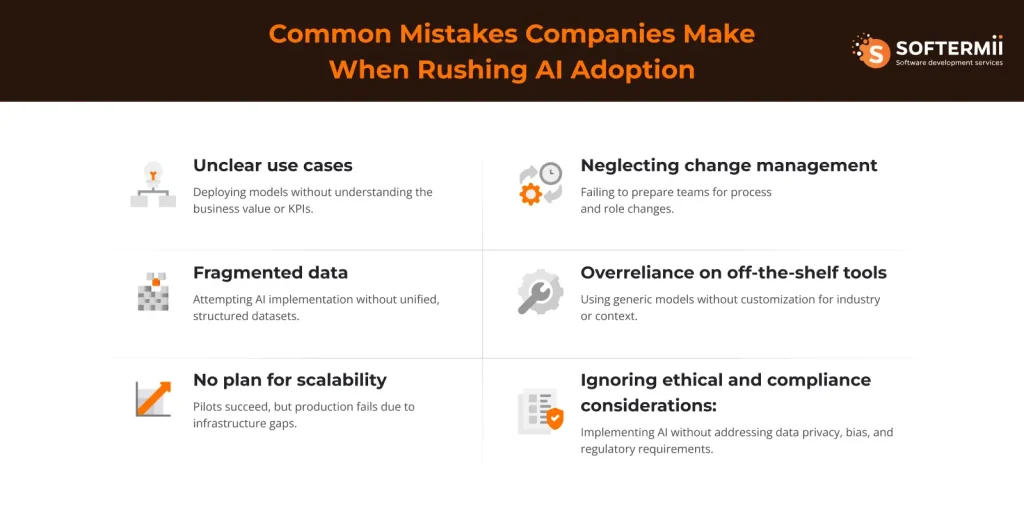
Many organisations adopt AI for the sake of trend alignment, leading to:
- Unclear use cases: Deploying models without understanding the business value or KPIs.
- Fragmented data: Attempting AI implementation without unified, structured datasets.
- Overreliance on off-the-shelf tools: Using generic models without customisation for industry or context.
- Neglecting change management: Failing to prepare teams for process and role changes.
- No plan for scalability: Pilots succeed, but production fails due to infrastructure gaps.
- Ignoring ethical and compliance considerations: Implementing AI without addressing data privacy, bias, and regulatory requirements.
Avoiding these pitfalls requires upfront alignment, long-term planning, and organisational preparedness.
AI-Readiness Checklist for Stakeholders
Several core elements should be addressed so businesses can confidently shift from experimentation to value generation. The following checklists outline key areas for each sector. While not exhaustive, they highlight the main priorities to evaluate your company’s readiness before moving forward:
Healthcare
- Our company has secure access to high-quality, structured, and standardised patient data.
- We ensure compliance with healthcare data regulations such as HIPAA.
- Protocols for patient privacy and data anonymisation are in place.
- We support AI workloads with scalable on-premises or cloud infrastructure.
- Medical devices and EHRs are seamlessly integrated with our systems.
- Real-time data processing and AI model inference capabilities are supported.
- Clinicians and IT staff receive training on AI fundamentals and benefits.
- Collaboration channels between data scientists and healthcare professionals are actively maintained.
- We are open to AI-driven clinical decision support and automation.
- Clear AI ethics and governance policies address healthcare-specific risks.
- We have defined processes for AI validation, monitoring, and ongoing model updates.
- Risk management protocols mitigate potential AI errors impacting patient care.
Fintech
- Reliable access to real-time financial transaction data is in place.
- We comply with financial regulations such as PCI-DSS, KYC, and AML.
- Strong encryption and fraud prevention measures protect sensitive data.
- Our infrastructure supports low-latency, large-scale AI computations.
- We integrate AI with banking APIs, payment gateways, and trading platforms.
- Secure and traceable AI model deployment and auditing processes are established.
- Our teams know AI, finance, and regulatory requirements.
- We promote responsible AI use in risk management and customer experience.
- Ongoing training addresses new AI applications and risks in fintech.
- Clear governance frameworks guide AI-driven financial decisions.
- Processes ensure AI model explainability and audit trails meet regulatory standards.
- Incident response plans for AI failures affecting financial operations are ready and tested.
E-commerce
- Complete access to customer behaviour, inventory, and sales data is secured.
- Compliance with consumer data protection laws (e.g., GDPR, CCPA) is guaranteed.
- Secure handling of payment and personal customer information is enforced.
- Our cloud infrastructure scales to support AI personalisation and recommendations.
- AI integrates seamlessly with CRM, ERP, and marketing automation systems.
- Real-time AI-powered customer interactions are enabled.
- Marketing, sales, and data teams understand AI use cases in e-commerce.
- Our culture embraces data-driven personalisation and automation.
- Training programs focus on AI-powered customer insights and trend forecasting.
- Procedures for testing AI recommendations and promotions before release are in place.
- We monitor AI-driven pricing, inventory, and fraud detection systems.
- Customer feedback is regularly incorporated into AI model improvements.
Real Estate
- Access to property, market, and client data from multiple sources is established.
- We comply with local real estate and data privacy regulations.
- Sensitive client and financial information is securely stored and handled.
- Platforms integrate AI tools for property valuation and lead scoring.
- Our cloud infrastructure supports geographic data processing for AI applications.
- AI is applied in virtual tours, chatbots, and predictive analytics.
- Agents, analysts, and IT staff receive training on AI tools and market insights.
- Our culture supports AI augmentation in sales, marketing, and property management.
- Collaboration between real estate experts and AI developers is established.
- Governance policies cover AI recommendations impacting client investments.
- Processes exist for validation and ongoing improvement of AI valuation models.
- Risk management addresses AI bias and ensures transparency.
Audio/Video Conferencing
- Secure handling of audio, video, and user metadata aligns with privacy laws.
- Data retention policies comply with user consent and legal requirements.
- Strong encryption standards protect all communications.
- Our infrastructure supports low-latency, high-bandwidth AI-powered features.
- Integration with collaboration tools and APIs is functional.
- We have scalable AI resources for real-time transcription, translation, and noise cancellation.
- Engineering and product teams are skilled in AI and signal processing.
- We foster a user-centric mindset, encouraging AI-enhanced feature adoption.
- Teams receive ongoing training on AI ethics related to user data and consent.
- Clear policies govern AI use in content moderation, transcription, and analysis.
- AI performance and user feedback are monitored regularly.
- Security protocols prevent misuse of AI-enabled conferencing tools.
Logistics
- We have access to real-time, structured data across shipments, inventory, and transportation flows.
- We comply with international and local data regulations related to logistics and supply chains.
- Data from suppliers, carriers, and warehouses is standardised and integrated.
- Our infrastructure supports large-scale route optimisation and demand forecasting algorithms.
- Systems integrate with third-party logistics (3PL), telematics, and warehouse management platforms.
- Real-time AI model inference is enabled for scheduling, tracking, and capacity planning.
- Operations and supply chain teams are trained in AI-supported decision-making.
- Our company encourages using AI to improve delivery performance, reduce operational costs, and minimise delays.
- Cross-functional collaboration between IT, operations, and procurement supports successful AI implementation.
- We have governance processes for auditing AI decisions that affect logistics timelines and budgets.
- Predictive analytics and scenario modelling tools are regularly tested, refined, and updated.
- Risk management protocols account for disruptions due to inaccurate forecasts or external supply chain shocks.
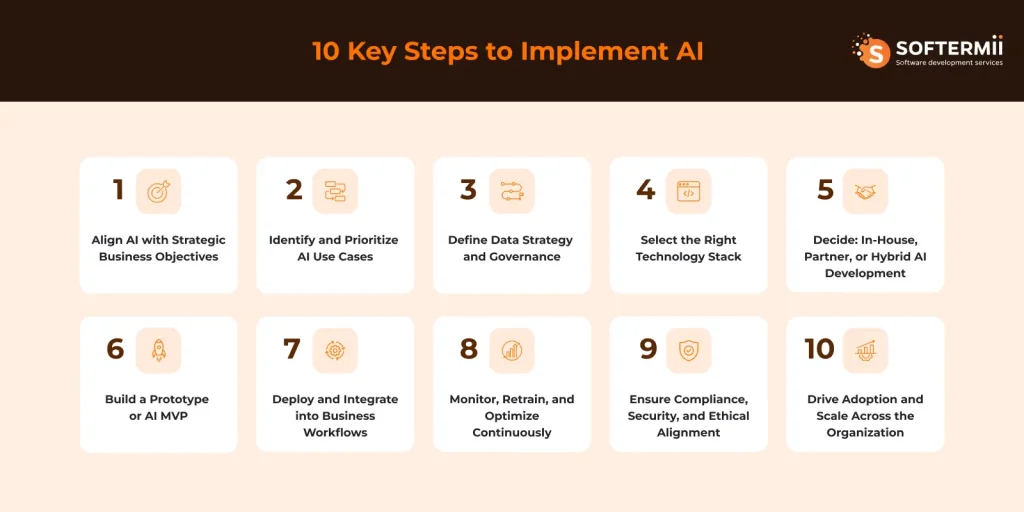
10 Key Steps to Implement AI
Successfully implementing AI demands a structured process that aligns technology with business goals. These 10 steps outline a practical path from initial vision to enterprise-wide adoption:
1. Align AI with Strategic Business Objectives
Begin with clarity. Identify where AI can directly support core business goals. It can be cost reduction, faster decision-making, better customer experiences, or new revenue streams. AI should serve the strategy, not the other way around.
2. Identify and Prioritise AI Use Cases
Evaluate potential use cases by feasibility and impact. Start with high-value and low-complexity opportunities that can generate quick wins. Prioritisation should also consider data availability and operational readiness.
3. Define Data Strategy and Governance
AI success hinges on clean, structured, and accessible data. Establish a governance framework to ensure data quality, consistency, privacy, and lifecycle management. Build data pipelines that are scalable and AI-compatible.
4. Select the Right Technology Stack
Choose platforms, tools, and infrastructure that match your AI maturity, use cases, and scalability needs. Consider factors like model interoperability, integration with existing systems, and long-term maintenance.
5. Decide: In-House, Partner, or Hybrid AI Development
Evaluate your internal capabilities against the complexity of the project. In-house gives more control, partners bring speed and expertise, and hybrid models offer flexibility. The right decision balances time-to-market, costs, and ownership.
6. Build a Prototype or AI MVP
Develop an MVP to validate assumptions, assess technical feasibility, and measure early performance. Use this phase to collect feedback, refine your models, and prove business value before scaling.
7. Deploy and Integrate into Business Workflows
A successful AI model is only valuable if embedded in real operations. Work closely with product and process owners to ensure seamless integration. Provide user-friendly interfaces and clear outputs to maximise adoption.
8. Monitor, Retrain, and Optimise Continuously
AI is not static. Monitor model performance in production, retrain with fresh data and fine-tune based on changing inputs and business needs. Establish clear KPIs and automation for model lifecycle management.
9. Ensure Compliance, Security, and Ethical Alignment
Implement AI responsibly. Your models must comply with local and global regulations. They also should protect sensitive data and reflect ethical standards such as fairness, transparency, and accountability.
10. Drive Adoption and Scale Across the Organisation
Support adoption through training, documentation, and change management. Engage stakeholders early, communicate benefits clearly, and foster an AI-ready culture. Scale successful pilots into enterprise-wide capabilities.
Integrate AI seamlessly into your workflows. Contact us to discuss your business goals.
Key Challenges and How to Overcome Them
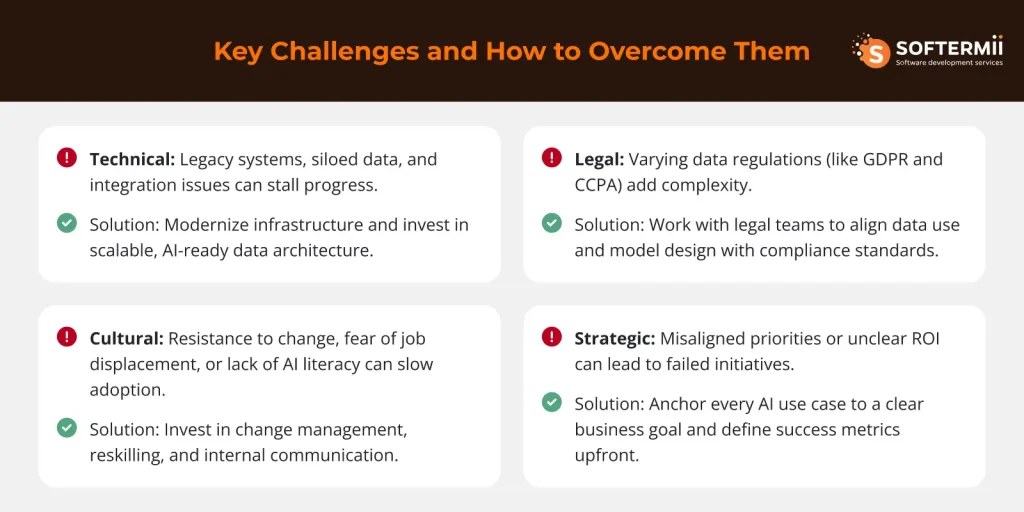
Organisations often encounter technical, strategic, cultural, and regulatory hurdles. Addressing these challenges early is critical for sustainable AI adoption.
Technical, Strategic, Cultural, and Legal Barriers
AI success demands alignment across systems, strategy, and people.
- Technical: Legacy systems, siloed data, and integration issues can stall progress.
Solution: Modernise infrastructure and invest in scalable, AI-ready data architecture. - Strategic: Misaligned priorities or unclear ROI can lead to failed initiatives.
Solution: Anchor every AI use case to a clear business goal and define success metrics upfront. - Cultural: Resistance to change, fear of job displacement, or lack of AI literacy can slow adoption.
Solution: Invest in change management, reskilling, and internal communication. - Legal: Varying data regulations (like GDPR and CCPA) add complexity.
Solution: Work with legal teams to align data use and model design with compliance standards.
Navigating the Talent Shortage
70% of companies face AI skill gaps, making building or scaling teams difficult.
Solution:
- Leverage hybrid delivery models. Combine internal teams with external partners to fill gaps.
- Invest in upskilling through AI literacy programs, technical training, and cross-functional onboarding.
- Adopt no-code/low-code AI platforms. Empower business units and reduce dependency on highly specialised roles.
Ethics, Explainability, and Regulatory Pressures
Stakeholders expect AI decisions to be transparent, fair, and accountable, a critical factor in high-impact sectors like healthcare, finance, or HR.
Solution:
- Use explainable AI (XAI) frameworks to make model decisions interpretable.
- Regularly audit models for bias, drift, and unintended consequences.
- Embed ethical guidelines into development workflows, from data sourcing to output validation.
AI Governance Models You Can Apply Today
Without governance, AI projects often lack direction, accountability, and scalability.
Solution: Adopt one of these foundational AI governance models:
- Centralised: A dedicated AI/ML CoE defines standards and ensures department consistency.
- Federated: Business units run AI projects independently but align to shared principles and infrastructure.
- Hybrid: Combines centralised oversight with decentralised innovation. This model is ideal for scaling across large organisations.
Any chosen models should include policies for model lifecycle management, data access, compliance, security, and performance monitoring.
Our Expertise
At Softermii, we approach AI implementation as a core enabler of business outcomes. We combine 11 years of technical expertise with agile processes and a deep understanding of industry requirements. Our team has delivered end-to-end solutions combining deep domain knowledge and advanced technologies.
Events10X: Hybrid & Virtual Events Platform
One such project is Events10x, a scalable platform designed to simplify the organisation of large-scale hybrid and virtual events, connecting thousands of participants worldwide.
Business Benefits:
- Simplified Event Management: Easy setup and management of large conferences and webinars
- Smarter Networking: AI matchmaking connects participants based on their interests and objectives.
- Global Accessibility: Multi-device support allowing attendees to join from anywhere
- Seamless Integration: Custom payment and ticketing solutions adapted to regional requirements
Main Features:
- Video Calls: One-on-one and group conferencing
- Live Broadcasting: Streaming to large audiences
- Messaging: Real-time participant communication
- AI Matchmaking: Intelligent participant connection suggestions
- Virtual Spaces: Customizable hubs simulating event venues
HIPAA Telmed: Telemedicine App
In the healthcare space, we developed HIPAA Telmed. It’s a fully compliant telemedicine platform tailored for the US market. The solution integrates AI to support clinicians during consultations. It automatically transcribes and summarises patient consultations. HIPAA Telmed is built on a privacy-first framework, ensuring data security and regulatory alignment at every layer.
Business Benefits:
- Improved Access: Facilitates efficient remote healthcare delivery
- Workflow Automation: AI transcribes and summarises patient consultations
- Better Communication: Improves interaction between patients and providers
- Data Security: Fully compliant with healthcare privacy regulations.
Main Features:
- Secure Consultations: Video and audio calls with reliable quality
- Appointment Management: Scheduling and calendar integration
- Document Sharing: Secure exchange of medical records
- AI Transcription: Automated creation of visit summaries
- Payment Processing: Integrated online payment for medical services
Conclusion
Implementing AI in 2025 requires strategic alignment, the proper infrastructure, and a clear execution plan. In this guide, we covered why AI is no longer optional, how to assess your organisation’s readiness, key steps for implementation, common challenges, and the measurable benefits of getting it right.
Softermii delivers practical, scalable, and tailored AI solutions to your business needs. Our team helps companies turn ambitious ideas into scalable, secure solutions. Contact us, and we’ll build AI that works for your business.
About Slava Vaniukov: Slava is a tech entrepreneur with over a decade of experience in the IT industry. After getting extensive experience as a senior mobile lead and mentor with the focus on MVP development and UX/UI design, Slava joined forces with like-minded professionals to start Softermii and helping startup founders to design and develop innovative tech products.
Hero image credit: Softermii