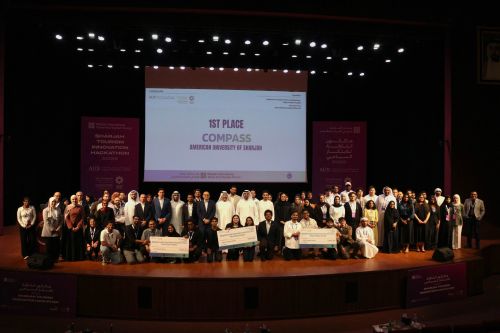
A multidisciplinary team of American University of Sharjah (AUS) students won first place at the second Sharjah Tourism Innovation Hackathon with RIHLA, a platform that combines technology and local heritage to create curated hiking experiences along Sharjah’s east coast.
AUS and the Sharjah Commerce and Tourism Development Authority (SCTDA) co-organized the hackathon, an annual initiative established under a Memorandum of Understanding signed by the two institutions in April 2026. More than 200 teams, representing over 800 students from 29 universities across six emirates, applied. Twenty teams comprising 80 students from 15 universities were shortlisted. The competition was open to undergraduate students across the UAE, with multidisciplinary teams given priority.
Under the theme “Innovating the Sustainable Future of Tourism,” teams spent two days developing solutions to tourism challenges in Sharjah or the UAE. Ideas could address visitor experiences, accessibility, sustainability, cultural preservation or emerging technologies. Finalists delivered five-minute pitches followed by a three-minute question-and-answer session. Judges assessed each project’s viability, impact, innovation, clarity, relevance and presentation quality.
RIHLA combines an AI-powered trip assistant, near-field communication (NFC) trail check-ins, heritage stories, rewards and real-time trail monitoring using IoT sensors. It connects visitors with nearby attractions and services, and encourages sustainable tourism through existing infrastructure, solar-powered sensors and public transport.
Team Compass received AED 20,000 for first place. Its members are Mohammed Zafar, a sophomore in computer engineering; Pavan Lokesh, a junior in finance; Sarah Mulla, a junior in computer engineering; and Amira Qasim, a sophomore in economics.
“Tourism innovation depends on understanding how visitors experience a destination and how new ideas can create lasting value for the sector,” said Dr. Imran Zualkernan, Professor and Head of the Department of Computer Science and Engineering at AUS. “RIHLA brings together technology, Sharjah’s heritage and sustainable mobility, while the competition’s cross-disciplinary teams show how collaboration can help shape tourism solutions with practical potential.”
“The Sharjah Tourism Innovation Hackathon is a platform to reimagine the future of tourism and develop solutions that serve our community,” said Niama Abdalla Al Ali, Manager of the Strategy and Corporate Excellence Department at SCTDA. “It is an opportunity to exchange ideas, strengthen partnerships and develop practical solutions aligned with Sharjah’s vision for sustainable tourism. Through our partnership with AUS, we continue to empower young people and involve them in shaping the future of the sector. Together, we can build a tourism ecosystem driven by artificial intelligence, innovation and sustainability, one that reflects Sharjah’s rich cultural heritage and its aspirations for the future.”
Second place and AED 15,000 went to team Deception from the University of Birmingham Dubai for HURUF – Read the Light. The concept uses modular canopies to cast Arabic words in public spaces, with a multilingual app that shares their meanings and stories as visitors follow a tourism route. The team proposed using materials made from date-palm waste. Its members are Wasif Waseem, Yaser al Sarraf, Rayan Sameer and Hussain Sabuwala.
Third place and AED 10,000 went to team 404: Footprint not Found from Curtin University Dubai for UnTrace. The platform processes hotel utility bills and operational data to track carbon, water, energy and waste, support sustainability reporting, identify anomalies and recommend cost-saving actions. Its members are Diluksh Fernando, Harishma Kumar, Nihalsharafuddeen Chakkipparamban and Abdul Wahab.
For participants, the hackathon offered a chance to explore tourism and startups, develop ideas under pressure and learn from mentors.
“I gained valuable experience and learned more about tourism and startups. We developed ideas and business plans in a focused environment, which challenged us to work under pressure. Our mentors and organizers created a welcoming atmosphere that encouraged us to push ourselves further. I am grateful to everyone who made this event possible,” said Behzad Davari, a junior majoring in computer science at AUS.
The opening ceremony featured remarks from H.E. Khalid Jasim Al Midfa, Chairman of SCTDA, and Dr. Tod A. Laursen, Chancellor of AUS. The program also included a panel discussion moderated by AUS alumnus Mahmoud Darwish, a member of the first edition’s winning team. Panelists represented industry, Sharjah Entrepreneurship Center (Sheraa), the AUS School of Business Administration and the AUS Artificial Intelligence, Smart Infrastructure and Robotics (ARC) Research Center.
A session arranged by the Telecommunications and Digital Government Regulatory Authority (TDRA), titled “From Tourism Challenges to Innovative Startups,” featured Eng. Mohamed Aboud, Co-founder and Chairman of Global Innovation and Entrepreneurship Company.
The first-place team will present RIHLA on the main stage at the Sharjah International Travel and Tourism Forum 2026. The top three teams will also receive startup mentorship from Sheraa and the AUS ARC Research Center to help them explore entrepreneurship pathways and develop their concepts.
At AUS, the hackathon was organized by the Department of Computer Science and Engineering in the College of Engineering, with support from the School of Business Administration and the Office of Advancement and Alumni Affairs. Sheraa joined as ecosystem partner.
By bringing students and tourism stakeholders together, the hackathon aimed to advance ideas that could support a more sustainable visitor experience in Sharjah and the UAE.