Mubadala Investment Company and Khalifa University of Science and Technology have announced the launch of the Life Sciences Innovation Programme (LSIP), a strategic initiative designed to accelerate medical research, develop advanced healthcare technologies and strengthen the UAE’s growing life sciences sector.
The programme aims to bridge the gap between academic research and commercial applications, with a focus on early-stage innovation in therapeutics, medical devices and other healthcare solutions.
The initiative will be jointly managed by Mubadala Bio, Mubadala’s wholly owned life sciences company, and Khalifa University Enterprises Company (KUEC), the university’s business and investment arm. Khalifa University will serve as the programme’s delivery partner, contributing its scientific expertise, research facilities and academic talent.
Strategic Partnership to Strengthen UAE Life Sciences Sector
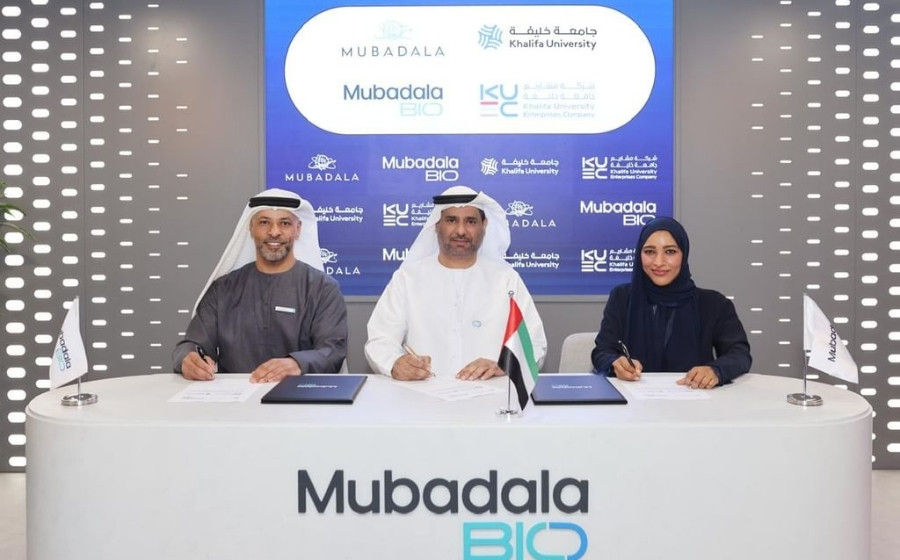
The partnership agreement was formally signed during the Abu Dhabi Future Health Summit by Dr. Bakheet Al Katheeri, Chief Executive Officer of Mubadala’s UAE Investments Platform and Chairman of Mubadala Bio; Professor Ebrahim Al Hajri, President of Khalifa University of Science and Technology; and Amal Al Jaberi, Chief Executive Officer of Khalifa University Enterprises Company.
The collaboration brings together the research capabilities of Khalifa University, the industrial expertise of Mubadala Bio and the commercialisation experience of KUEC.
By combining these resources, the partners aim to accelerate the development of locally researched healthcare technologies while creating opportunities for innovation, investment and knowledge-based economic growth.
Research Programme to Target Major Healthcare Challenges
Under the Life Sciences Innovation Programme, Mubadala and KUEC will jointly finance a portfolio of research projects addressing critical healthcare needs.
The programme will focus on several therapeutic areas aligned with Mubadala Bio’s priorities, including cardiometabolic diseases, central nervous system disorders, oncology, musculoskeletal conditions, and men’s and women’s health.
Particular attention will be given to medical conditions where existing treatment options remain limited, creating opportunities for researchers to explore new therapeutic approaches and technologies.
The initiative is also expected to support the development of intellectual property and encourage the commercialisation of promising scientific discoveries.
Mubadala Bio Plans Advanced Research Laboratory in Abu Dhabi
Alongside the programme, Mubadala Bio intends to establish a commercial research and development laboratory at Khalifa University’s main campus, within the College of Medicine and Health Sciences.
The proposed facility will provide researchers and students with opportunities to participate in the development of advanced medicines and innovative healthcare technologies.
The laboratory is expected to concentrate on complex, high-value pharmaceutical products, potentially including sterile injectable medicines, peptides and RNA-based therapies.
It will also support Mubadala Bio’s manufacturing companies in the UAE, alongside academic institutions and industry partners working to advance pharmaceutical research and production capabilities.
Partnership Aims to Turn Scientific Discoveries into Healthcare Solutions
Professor Ebrahim Al Hajri highlighted the importance of connecting academic research with industry expertise to expand the UAE’s scientific capabilities.
He said the partnership would bring together Khalifa University’s research infrastructure and talent with Mubadala Bio’s industrial experience, creating new opportunities to develop advanced technologies and strengthen collaboration between universities and businesses.
According to Al Hajri, the initiative will help establish national capabilities while enabling scientific discoveries to generate long-term economic and societal benefits.
Amal Al Jaberi emphasised the programme’s role in transforming university research into practical healthcare solutions and commercial opportunities.
She explained that supporting research commercialisation, developing locally owned intellectual property and expanding the UAE’s knowledge base would help establish new industrial sectors.
These efforts are intended to improve the country’s ability to develop, own and scale innovative technologies.
Supporting Pharmaceutical Manufacturing and Economic Resilience
Dr. Bakheet Al Katheeri stressed that expanding domestic pharmaceutical manufacturing is essential to strengthening the UAE’s healthcare supply chain and reducing dependence on imported medicines.
He noted that creating a competitive life sciences industry requires investment and collaboration throughout the entire development process, from scientific research to large-scale manufacturing.
The partnership, he added, supports the UAE’s broader ambition to establish a more resilient and knowledge-driven economy.
By connecting research institutions with industrial capabilities, the programme seeks to develop a stronger foundation for pharmaceutical innovation and advanced healthcare manufacturing within the country.
The launch of LSIP represents another step in the UAE’s efforts to expand its life sciences industry, encourage homegrown medical innovation and strengthen Abu Dhabi’s position as a centre for healthcare research and advanced pharmaceutical development.