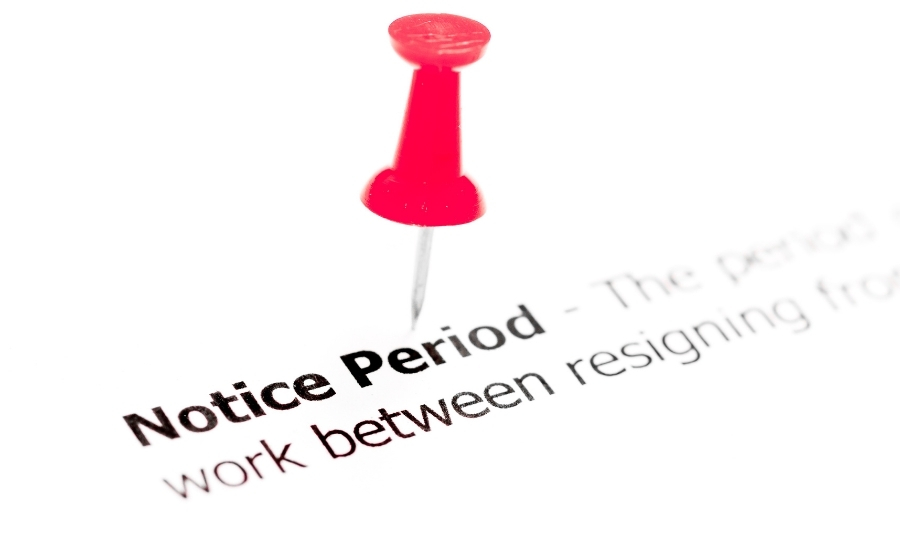
Resigning from a job or ending an employment contract is rarely as simple as choosing a final working day. In the UAE, employees and employers generally need to give written notice, observe the agreed notice period and complete the final settlement. Understanding the rules early helps both sides avoid disagreements about pay, handovers and contract dates.
What is the standard notice period in the UAE?
Under Article 43 of Federal Decree-Law No. 33 of 2021, the usual notice period for private-sector employment is between 30 and 90 days. The actual period comes from the employment contract: a worker with a 60-day clause should not assume that giving only 30 days is sufficient. The same general rules apply whether the employee resigns or the employer ends the contract for a lawful reason.
Notice must be given in writing. During the notice period, the employment relationship continues and the employee normally performs their duties while receiving their full wage based on the latest salary. The contract ends when the notice period expires, unless the parties lawfully agree to a different arrangement.
How to resign or terminate employment correctly
The first step is to read the signed contract and confirm the notice clause. The employee should then send a dated resignation letter or email to the designated manager or HR contact. When termination is employer-initiated, the employer should issue a written notice stating the proposed final day.
Keep copies of the notice and any written agreement about the final date. Both parties should also agree on handover responsibilities, outstanding work, company property and the timing of work-permit or residency formalities. An employee should not treat a resignation message alone as permission to stop attending work immediately.
For a broader explanation of employee and employer obligations, this guide to the notice period in the UAE covers the statutory range, practical steps and common termination scenarios.
What happens if the full notice is not served?
Either party may request a shorter notice period, but an early release should be agreed in writing and should preserve the relevant legal rights. Without a valid agreement or applicable legal exception, the party that fails to observe the required notice can owe compensation calculated using the employee’s last wage for the unserved period.
For example, suppose a contract requires 30 days of notice but an employee leaves immediately without agreement. A notice-period allowance may be payable, even if the employer cannot demonstrate a specific financial loss. The same principle can apply when an employer ends the relationship without the required notice. Exact calculations should be checked against the contract and circumstances.
Different rules apply during probation
Probation has its own notice requirements. An employer wishing to terminate employment during probation must generally give at least 14 days’ written notice. A worker moving to another employer within the UAE during probation generally has to give at least one month’s written notice, while a foreign worker resigning during probation to leave the country generally gives at least 14 days.
Additional recruitment-cost and work-permit consequences can arise in some probation exits, so employees should not simply apply the ordinary 30-to-90-day rule to these cases.
Pay, leave and final settlement
Employees are entitled to their usual wage while working through the notice period. If the employer terminates the contract, the worker is also entitled to one unpaid day per week during notice to look for another job, provided the employer is told at least three days beforehand.
The employer should reconcile outstanding wages, unused annual leave and any applicable end-of-service gratuity. Under the federal private-sector law, the final amounts due must generally be paid within 14 days of the contract ending. Documented calculations can prevent misunderstandings about deductions or missing leave days.
Common mistakes that lead to disputes
Problems often arise when someone assumes every contract has a 30-day notice period, gives notice verbally, leaves before a written early-release agreement or overlooks probation rules. Termination without notice is possible only in specific legal circumstances and should not be treated as an ordinary shortcut. Special employment regimes, including DIFC and ADGM, may have different rules.
Why this matters for growing companies
Entrepreneurs setting up through Meydan Free Zone should build clear notice clauses, resignation procedures and final-settlement checks into their employment documentation. A short internal checklist can make staff changes easier to manage without turning a routine transition into a legal dispute.